From Flag to Wire
7/24/2026
How the U.S. Army Signal Corps and the United States Military Telegraph Actually Worked Together
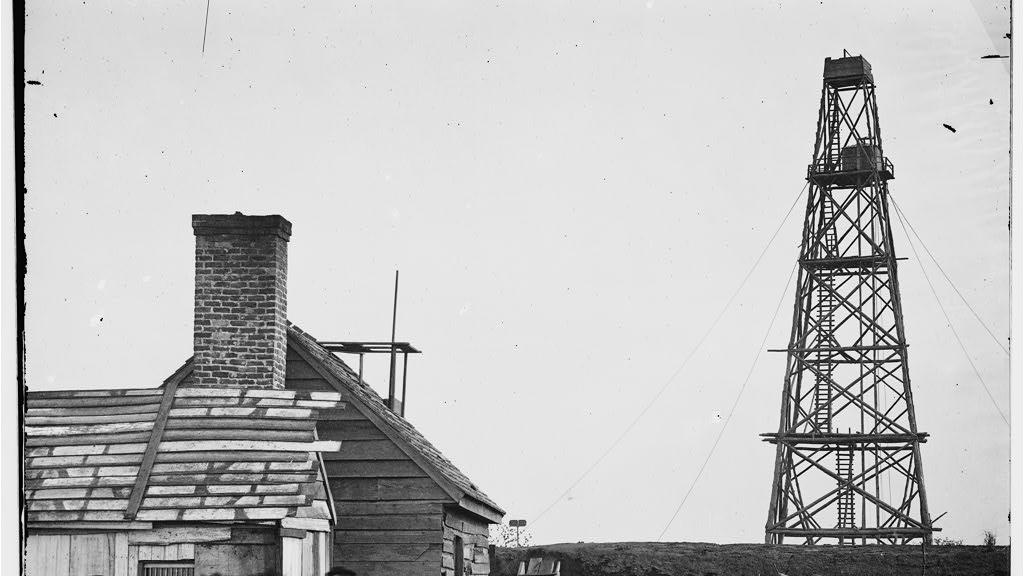
Butler’s signal tower at Bermuda Hundred, Virginia, in 1864. Elevated stations allowed Signal Corps personnel to observe the battlefield and exchange messages by flag during the day or torch at night. Cropped from a Library of Congress photograph; no known restrictions on publication.
The Essential Distinction
The U.S. Army Signal Corps was a uniformed military organization whose wartime work centered on visual signaling, observation, and—during part of the war—portable electrical telegraphy.
The United States Military Telegraph was a separate War Department service staffed predominantly by civilian telegraph professionals. It operated the larger Morse network connecting armies, departments, railroads, supply centers, and Washington.
They were not the same organization. They did not operate under one settled command structure. They sometimes cooperated, sometimes worked in parallel, and sometimes fought for control of the same mission.
After the Civil War, the Signal Corps became the Army’s permanent communications branch. The USMT was disbanded, and its functions were absorbed into the Signal Corps.
A Message Changes Systems
During the Atlanta Campaign of 1864, the Union telegraph line serving Allatoona repeatedly failed.
Confederate detachments cut the wire faster than it could be kept open. Major General William T. Sherman therefore directed Signal Corps personnel to establish visual communication across the intervening country.
A dispatch could now travel over part of its route by flag.
At Allatoona, the received message was written down and placed onto a surviving telegraph circuit for transmission to Rome, Georgia, where Brigadier General John M. Corse could act upon it.
One message had passed through two different communications systems.
It had begun as movements of a signal flag visible across miles of terrain. At the next stage, a telegraph operator converted the written dispatch into electrical impulses traveling over wire. The transfer was not automatic. A signalman received and recorded the visual message; someone carried or presented it to the telegraph office; and a different operator transmitted it using a different code and instrument.
A few days later, during the Battle of Allatoona, Signal Corps personnel again communicated across territory where ordinary routes had been severed. Sherman’s encouragement to the defenders—later transformed in popular memory into the phrase “Hold the fort”—was sent visually because the enemy had interrupted other means of communication.
Allatoona offers one of the clearest answers to a question that remains misunderstood:
How did the Signal Corps and the United States Military Telegraph actually work together?
The answer is not that one service simply passed every message to the other according to a universal procedure. No such perfectly integrated system existed.
Instead, commanders and communications personnel assembled a chain from whatever means were available:
- visual flags or torches,
- mounted or foot couriers,
- portable field telegraph lines (line just running in the grass),
- permanent or semi-permanent Morse circuits,
- railroad and commercial connections.
The Signal Corps and the United States Military Telegraph occupied different parts of that communications chain. With their responsibilities overlapped, the boundary between them became the subject of one of the most persistent organizational disputes in the Union war effort.
Yet when the wires were cut, terrain blocked the flags, or an army moved beyond both systems, practical necessity often mattered more than institutional rivalry.
Two Services, One Communications Problem
Modern readers naturally group the Signal Corps and military telegraphy together. Both carried military messages. Both worked near headquarters. Both used technical equipment unfamiliar to ordinary infantrymen. Both helped the Union Generals leading armies reach across distances that would otherwise require a courier.
The modern U.S. Army Signal Corps eventually became responsible for electrical and electronic military communications very broadly, making it even easier to project the later organization backward into the Civil War.
That produces a misleading picture. During the war, Union military communications were divided among several organizations and methods. The two most important technical services were the Army’s signal organization and the War Department’s military telegraph network.
Their missions can be summarized in this way:
| Service | Principal wartime strengths |
|---|---|
| U.S. Army Signal Corps | Visual signaling by flag and torch; battlefield observation; tactical communication across visible terrain; limited portable electric telegraph operations |
| United States Military Telegraph | Professional Morse telegraphy; construction and repair of long-distance lines; operational and strategic communications; high-volume headquarters traffic; cipher work |
This distinction holds, but it isn't an absolute line.
The Signal Corps did more than wave flags. It also worked with portable electrical telegraph gear and ran field lines during major campaigns.
The USMT wasn't confined to permanent offices behind the lines either. Its construction crews followed the army as it advanced, stringing temporary wire and working out of tents and wagons rather than fixed buildings. They repaired lines that came under threat and opened stations pretty much wherever a commander needed one.
Where the two services really overlapped was in field electrical telegraphy.
That overlap led to cooperation at times, and friction at others.
What the Signal Corps Was
The Union signal service developed from the work of Albert J. Myer, an Army surgeon who devised a system for communicating across long distances through the motion of a single flag.
The system is now commonly called wig-wag signaling.
Unlike two-flag semaphore, Myer’s method used one flag moved through prescribed positions to represent elements of a code. At night, the same patterns could be made with torches.
A basic signal station normally required more than a lone flagman, two was the bare minimum, and three or four was more typical. Personnel had to:
- select a location visible from another station,
- identify landmarks and lines of sight,
- operate the flag or torch,
- observe through a telescope,
- record incoming groups accurately,
- encode outgoing messages,
- maintain contact with headquarters,
- and protect the station from enemy fire or capture.
Signal parties often worked from hills, rooftops, trees, church steeples, ship masts, and specially constructed towers.
Their elevated positions made them useful not only as communicators but also as observers. From a station, a signal officer might report troop movements, roads, smoke, camps, artillery positions, or changes in enemy activity.
Visual signaling possessed significant advantages. It required no continuous physical line between stations. A message could cross a river, ravine, occupied road, or other obstruction so long as the stations remained mutually visible. A broken railroad or cut telegraph wire did not matter to a flag line.
Visual signaling by its very name also had serious limitations. Fog, rain, smoke, darkness without properly placed torches, intervening timber, folds in the ground, and enemy occupation could interrupt communication. A signal station visible to its own army might also be visible to the enemy. Confederate signalmen learned to read Union traffic, and Union personnel likewise intercepted Confederate messages.
Even in good conditions, visual signaling carried less traffic than an efficiently operated Morse circuit. The official Army history estimates that flag signaling averaged only a few words per minute and normally worked across roughly ten to fifteen miles under favorable conditions.
Visual signaling was therefore especially valuable at the tactical edge: the zone where commanders, divisions, corps, ships, forts, and observation posts needed communication but where permanent wire had not been built or could not be maintained.
What the United States Military Telegraph Was
The United States Military Telegraph came out of a different world entirely — the commercial telegraph companies, railroads, and professional operators who ran the nation's wires before the war. When fighting broke out, civilian telegraph managers and employees helped secure Washington's communications and extend lines to newly occupied positions.
That organization is usually called the United States Military Telegraph, or USMT. Writers at the time and afterward often tacked on the word "Corps." William R. Plum himself used United States Military Telegraph Corps, though he acknowledged it wasn't a corps in the legal, Army-branch sense.
Most USMT operators were civilians on the War Department payroll, even when they worked inside army headquarters or traveled with commanders in the field. Some supervisors got Quartermaster Department commissions, since handling government funds and property required a military officer, but the people actually at the keys were mostly civilian telegraph professionals.
The service sat under the Quartermaster Department administratively, but answered unusually and directly to Secretary of War Edwin M. Stanton. Anson Stager was its general manager, and Thomas T. Eckert ran the Washington side of things, eventually overseeing the War Department telegraph office next to Stanton's own rooms.
USMT operators performed several kinds of work:
- operating Morse instruments,
- building and repairing lines,
- managing stations,
- routing traffic through relay points,
- maintaining batteries,
- diagnosing weak or grounded circuits,
- moving offices with headquarters,
- handling government and military messages,
- and encoding or decoding sensitive dispatches.
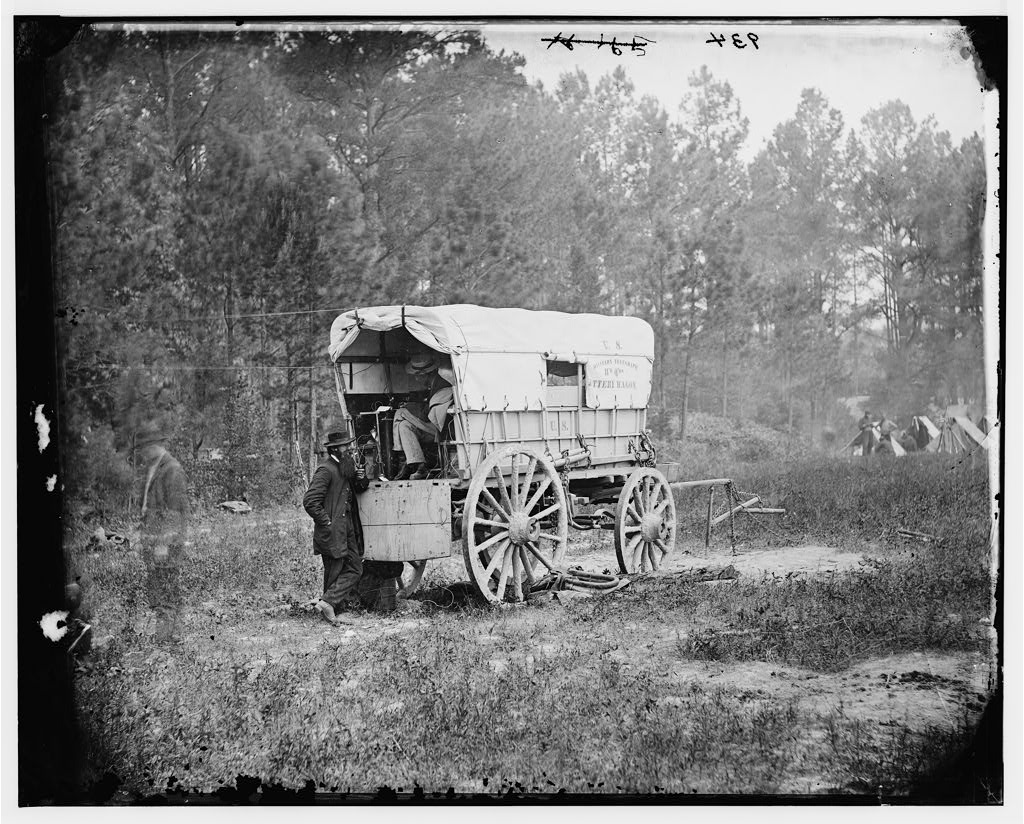
A U.S. Military Telegraph battery wagon at Army of the Potomac headquarters near Petersburg, Virginia, June 1864. Wagons carried batteries and equipment needed to support field telegraph operations. Photograph by David Knox, Library of Congress; no known restrictions on publication.
The USMT’s greatest advantage was capacity. Once a functioning circuit existed, a skilled operator could transmit a far greater volume of information than a visual station. Messages could travel beyond the horizon, through intermediate offices, and across hundreds of miles.
As we discussed in the opening, the largest weakness of the telegraph was the wire itself. A telegraph circuit depended upon a physical path. Cavalry could cut it. Guerrillas could remove sections. Retreating armies could destroy poles and bridges. Rain, vegetation, poor insulation, damaged batteries, and hasty construction could weaken the signal. A rapid advance might carry headquarters beyond the line before builders could follow.
The USMT was powerful because its system could reach great distances. The Signal Corps was powerful because visual communication could sometimes cross the exact gap where the wire stopped.
The Boundary That Never Settled
A simple division would have made institutional sense: the Signal Corps handling tactical communications near the battlefield, the USMT handling operational and strategic communications over longer distances. Something like that did eventually emerge, especially after 1863, but it was never cleanly established at the start of the war.
Myer believed the Army's signal service should control military communication in the field, electrical telegraphy included. To him, flags, torches, observation, and portable wire were all part of one battlefield communications job.
Stager, Eckert, and the commercial telegraph professionals saw it differently — electric telegraphy was a specialized technical service that needed trained Morse operators and centralized management.
Stanton trusted the USMT and its cipher operators, and their independence suited him: it gave him a communications organization that wasn't fully under the thumb of field commanders or the Army's traditional bureaus.
So the conflict ran deeper than equipment.
It involved:
- control of military information,
- authority over operators,
- responsibility for government property,
- access to ciphers,
- recruitment of skilled telegraphers,
- and the question of whether communications should answer primarily to commanders in the field or to the War Department.
The USMT’s cipher arrangements particularly troubled Myer.
Sensitive messages could be handled only by a limited number of trusted operators who possessed the correct keys. A commanding officer might control an army but remain dependent upon a civilian operator to translate his most confidential dispatches. In fact By 1864, the Secretary Stanton had issued an order forbidding commanding generals from interfering with even their own cipher operators, and restricted use of cipher books strictly to civilian telegraph experts approved and appointed by the Secretary of War.
From the USMT perspective, this restricted system protected the ciphers. From Myer’s perspective, it placed a critical military function outside the Signal Corps and outside of the ordinary chain of command of the Union military.
The result was not a partnership. It was an evolving, contested relationship between the military signal service and the War Department’s telegraph organization. The two services sometimes cooperated, sometimes worked in parallel, and sometimes competed for control of the same mission.
The Signal Corps Goes onto the Wire
Myer never intended the Signal Corps to stay purely visual.
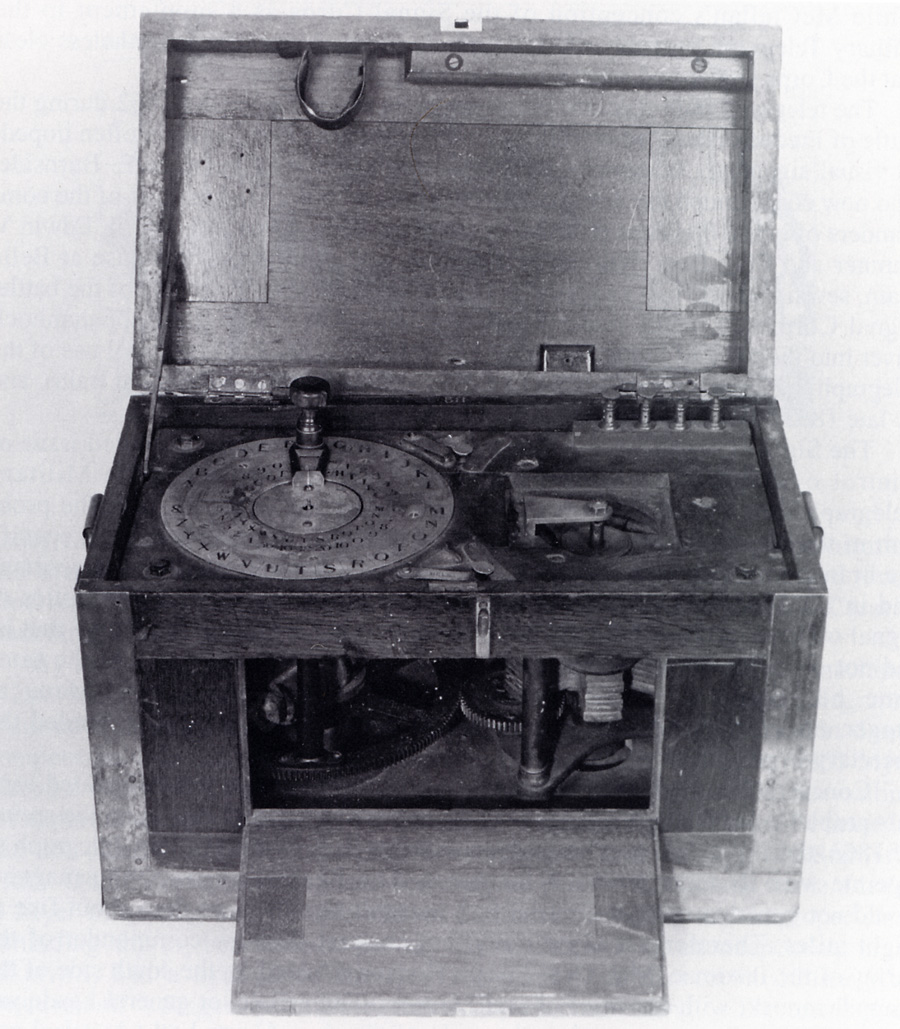
In August 1861, he asked Secretary of War Cameron to approve a portable telegraph train that could travel with the army — light wagons carrying instruments and insulated wire, with a construction party able to lay it fast along roads or straight across open ground to link headquarters with forward positions.
The Signal Corps tried several electrical systems, but the one it settled on was the Beardslee magneto-electric telegraph. Unlike the Morse equipment commercial operators used, the Beardslee ran on a hand-cranked dial: turn the lever to a letter, and the receiving instrument's pointer swung to match. That meant no Morse training and no bulky battery wagons, which made it attractive for tactical use but came with some fairly serious drawbacks that would come to a head later.
The Peninsula: A Line Laid with the Army
The Peninsula Campaign of 1862 gave the Signal Corps an early opportunity to operate portable telegraphy in the field.
On May 24, Signal Corps personnel established a line from general headquarters near the Gaines house to Brigadier General George Stoneman’s headquarters near Mechanicsville.
Wire was laid along roads and over the ground as headquarters shifted. The experiment exposed problems that would recur throughout the war. Soldiers unfamiliar with the system sometimes found the wire and cut it, believing it belonged to the enemy. Wagons, animals, troops, and civilians could damage a line laid directly along an active road.
The field telegraph nevertheless gave commanders a local electrical connection that could move with the army more readily than a conventional permanent line.
Visual stations and the portable wire did not make each other unnecessary. A flag station could reach an exposed point across a river or clearing without laying wire through contested ground. The telegraph could carry greater traffic between headquarters once a circuit existed. Couriers still connected positions beyond both.
The Peninsula therefore revealed the communications pattern that would characterize the war:
No single method was sufficient for effective battlefield communication.
Fredericksburg: A Tactical Telegraph Network
The Signal Corps expanded its field telegraph work during the Fredericksburg Campaign.
Portable lines connected Major General Ambrose Burnside’s headquarters with important subordinate commands and rear installations, including positions associated with Edwin V. Sumner, William B. Franklin, and Belle Plain.
During the operations at the Rappahannock, Signal Corps personnel extended a line across the river under fire in approximately twenty minutes.
This was precisely the kind of tactical work Myer believed belonged to his organization.
A portable line could follow the immediate plan of battle. It could connect an army commander with wing or corps headquarters without waiting for the commercial-style network to be rebuilt in a more permanent form.
Visual stations continued to operate where terrain and line of sight allowed them.
Fredericksburg became the high point of the Signal Corps’ independent wartime electrical program. It also intensified the dispute with the USMT.
From the viewpoint later expressed by Plum, the campaign showed that too much had sometimes been expected of visual signal officers while the army lacked enough dependable tactical telegraphy.
That assessment must be read as the argument of a USMT veteran. Plum spent much of his postwar career insisting that military telegraphers had been undervalued, and his writings were often dismissive of Signal Corps achievements.
Signal Corps veterans likewise wrote from the opposite institutional perspective.
The competing accounts are valuable because they expose the underlying problem. Both services recognized that an army needed rapid electrical communication near the front. Neither accepted that the other possessed an unquestioned right to control it.
Chancellorsville: When the System Failed
The limits of the Signal Corps’ Beardslee network became especially apparent during the Chancellorsville Campaign in 1863.
The Army of the Potomac operated across difficult, wooded terrain. Headquarters and major commands required rapid communication, but the environment frustrated visual signaling and complicated wire operations.
The Beardslee circuits became overloaded and unreliable. The instruments' limited range, the mechanical slowness of the dial itself, and the poor condition of the lines all contributed to delays and failures.
On May 1, USMT Morse operators were directed by the War Department to replace Signal Corps operators on part of the electrical network but what quickly became the entire network.
The USMT’s professional (non-mechanical) Morse equipment and operators offered stronger long-distance performance, but the change did not magically solve the army’s broader communications problem. Wires still had to survive in the Wilderness, and commanders still had to operate across broken terrain.
Chancellorsville demonstrated two truths at once:
- The Signal Corps had successfully brought portable electric telegraphy onto the battlefield.
- Its chosen equipment could not reliably carry the expanding demands placed upon it.
The campaign strengthened the argument that field electrical telegraphy should be placed under the professional USMT organization.
The Crisis of 1863
The institutional struggle reached its peak later that year.
Myer attempted to recruit trained Morse operators for the Signal Corps. This directly competed with the USMT for a limited pool of skilled telegraphers.
The dispute also involved control of field telegraph wagons, wire, instruments, and operators.
Signal Corps veteran J. Willard Brown later reproduced Myer’s warning that signal officers should resist attempts to take their electrical lines and place them under the commercial telegraph organization serving the War Department.
Secretary Stanton did not take kindly to Myer’s warnings and acted decisively. On November 10, 1863, Myer was removed as Chief Signal Officer. The Signal Corps’ field telegraph trains, instruments, and related property were transferred to USMT officials.
Myer and Stager later reached a proposed understanding for cooperation, but it was never fully implemented during the war. The transfer effectively ended the Signal Corps’ independent effort to become the Army’s principal electrical field communications service.
For the remainder of the conflict, the broad practical pattern became clearer:
- the USMT operated the principal electrical telegraph system;
- the Signal Corps concentrated upon flags, torches, observation, intelligence and tactical visual links.
None of this happened because one organizational theory won on the merits. It came down to bureaucratic conflict, Stanton's confidence in the USMT, the Beardslee's shortcomings, and the simple fact that professional Morse operators already ran the larger national network.
The USMT never adopted the Beardslee — its operators saw it as less dependable than a standard Morse key. But it did lean heavily on the idea the Signal Corps had proven: a mobile telegraph train that could lay temporary wire alongside an army.
The official Signal Corps history credits the USMT with building or running more than fifteen thousand miles of field, land, and submarine lines during the war. It also credits the Signal Corps with developing the Army's first rugged, portable battlefield electrical system.
Both are true. The organization that pioneered a technique isn't always the one that ends up running it at scale.
Port Hudson: A Formal Handoff
Port Hudson is a clear example of responsibility passing from the Signal Corps to the USMT. Lieutenant Milton Benner ran a Signal Corps electrical telegraph line there from May 23 to June 5, 1863. According to the Signal Corps veteran history, the line carried 245 messages averaging thirty-one words each. Benner was then ordered to hand the wire over to Captain David C. Bulkley of the United States Military Telegraph.
The incident is useful because it skips the vague talk of "cooperation." A working electrical line existed. Signal Corps personnel had run it. Responsibility was formally handed to a USMT officer. The wire itself might stay in place, but the organization controlling it changed.
This is one of the ways the two services actually worked together — not always side by side, and not always by choice, but in sequence: one built or ran a capability until command authority handed it to the other.
Chattanooga: Flags at the Tactical Edge
The campaigns around Chattanooga show why the Signal Corps remained valuable after losing control of most electrical telegraph work.
During the fighting around Lookout Mountain and Missionary Ridge, signal stations connected elevated and forward positions associated with commanders including Grant, Thomas, Sherman, Blair, and division leaders in Sherman’s force.
Signal officers transmitted orders and reports across sections of the battlefield where line of sight could be established.
The stations also served as observation points which could gather key intelligence. From high ground, signal personnel could watch roads, troop formations, enemy positions, and the progress of attacks. Their reports could reach commanders more quickly than a courier descending the mountain and crossing difficult terrain.
Visual signaling did not replace the wired network serving Chattanooga and its rear connections. It extended command communication beyond the practical end of that network.
This is the most accurate way to understand the practical relationship:
The Signal Corps often served as the communications layer between the moving tactical front and the nearest stable headquarters, while the USMT carried traffic outward through the larger wired network.
That pattern held often, but not always. Sometimes the signal station sat right next to headquarters. Sometimes a courier walked the message over to a telegraph office. Sometimes there was no wire at all, and it ended with the receiving commander. Sometimes the field telegraph actually reached farther forward than the flags did.
It came down to terrain and campaign, case by case.
Allatoona: Flag to Wire
And now back to the opening of this dispatch. The operations around Allatoona in October 1864 demonstrate the layered system at its most visible.
Sherman reported that the military telegraph line could not be kept open because Confederate forces repeatedly cut it.
Signal Corps personnel therefore opened visual communication.
A message sent by signal to Allatoona could be forwarded from there by telegraph to Rome, approximately thirty-six miles away, where Corse received orders connected with the defense of the railroad line and military stores.
The message did not and could not belong exclusively to either service:
-
The Signal Corps carried it across the broken portion of the route.
-
The telegraph carried it onward beyond the visual horizon.
Later, as Confederate forces attacked Allatoona, signal flags again crossed the enemy-interrupted landscape.
This was not merely two organizations working near one another. It was a true communications chain in which each system handled the section suited to its strengths.
If confidentiality mattered, a cipher added yet another layer of encoding and decoding on top of the relay, and each handoff along the way was one more chance for delay or error.
Flags and telegraphs were never mechanically or electronically linked with seemless conversion; what held the system together was the people running it.
Working Together "The Human Handoff"
The phrase “from flag to wire” can sound more seamless than the process actually was.
A typical combined chain might look like this:
Forward observer
↓
Signal station encodes the report
↓
Receiving signal station writes it down
↓
Courier or clerk carries the paper to headquarters
↓
USMT operator transmits it by Morse
↓
Cipher operator decodes it if necessary
↓
Headquarters clerk or messenger delivers it to the commander
A reply might return by the same route in reverse.
Again several different codes could appear within one journey:
- the Signal Corps visual code,
- ordinary written English,
- Morse transmission,
- and a War Department cipher.
The signal officer was not necessarily a telegraph operator.
The telegraph operator was not necessarily trained to work a flag station.
The courier or clerk connecting them was as important to the combined system as either instrument.
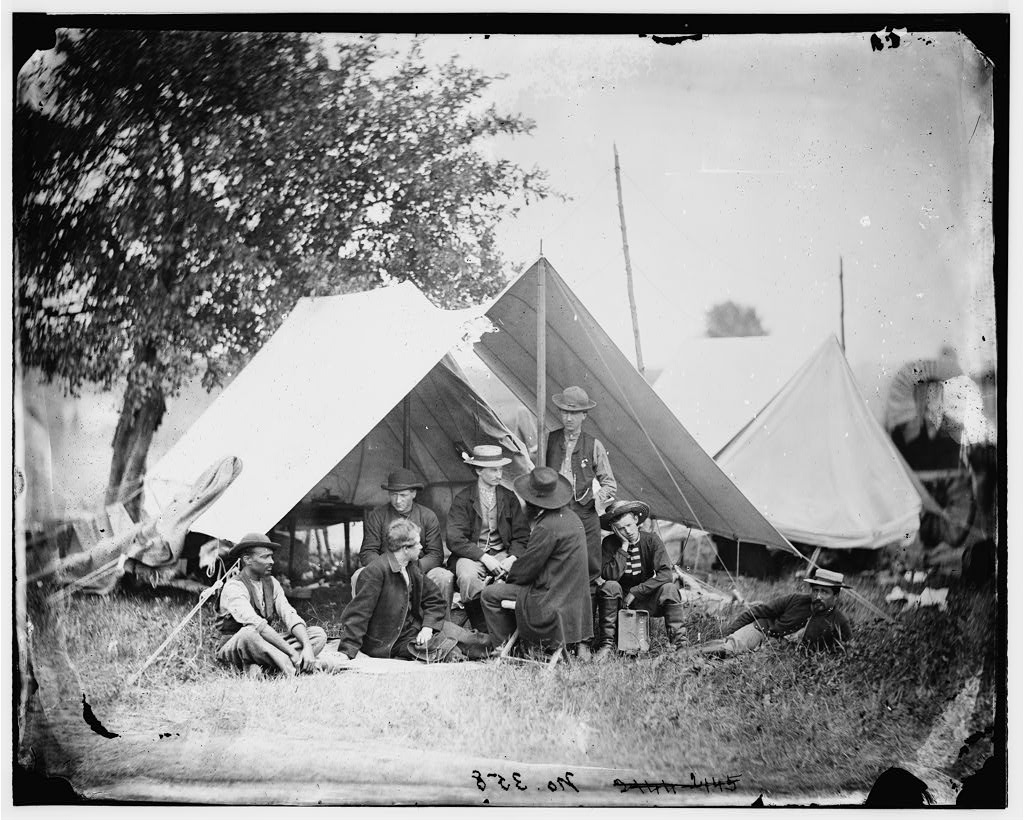
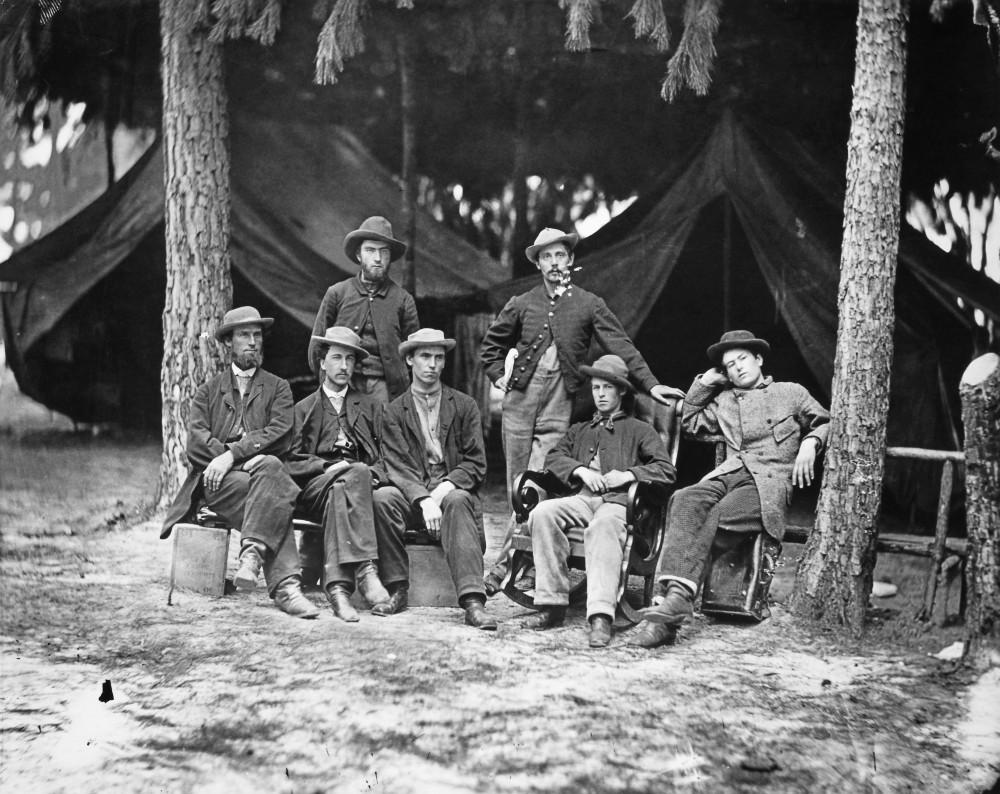
United States Military Telegraph operators at Army of the Potomac headquarters near Bealeton, Virginia, August 1863. Professional operators, clerks, builders, repairmen, messengers, and military staff all participated in moving information through the network. Library of Congress; no known restrictions on publication.
One Network, Unevenly Built
The Union didn't enter the Civil War with a single integrated communications service — it built one under pressure. The Signal Corps brought visual communication, battlefield observation, and the idea of a portable tactical telegraph into Army service. The USMT brought professional Morse operators, commercial telegraph experience, long-distance construction, and secure communication between senior headquarters.
Their relationship was untidy. They competed for operators and authority, and disagreed over equipment and ciphers. Stanton's removal of Myer settled the bureaucratic fight in the USMT's favor, giving it control of most electrical telegraphy — but that didn't make visual signaling obsolete.
Campaign after campaign showed why both were still needed. At Chattanooga, flags connected commanders and forward positions across difficult terrain. At Port Hudson, a Signal Corps electrical line passed into USMT hands. At Chancellorsville, USMT operators took over an overburdened Signal Corps system. At Allatoona, a message traveled by flag across a broken section of the line, then continued by telegraph to a commander miles away.
The organizations never merged. The message did.
That's the part most often lost when Civil War communications get reduced to a flag demonstration on one side or a telegraph key on the other. The Union command system worked because soldiers, civilian operators, builders, observers, couriers, clerks, and commanders learned to connect technologies that belonged to different organizations. The result wasn't a well-designed network — it was an improvised one, layered and contested, but increasingly capable.
When the wire ended, the flag could carry the message onward. When the flag ran out of sight, the wire could carry it past the horizon.
Six Myths That We As Reenactors Should Avoid
Myth 1: The Signal Corps operated all Union military telegraphs
It did not.
The principal wartime Morse network belonged to the United States Military Telegraph under the War Department. The Signal Corps operated portable electrical telegraphy during part of the war, but this mission became a major source of conflict and was largely transferred to the USMT after 1863. By the late war, especially in the Trans-Mississippi, the USMT was the dominant electrical telegraph service, and the Signal Corps concentrated on visual signaling, observation, and tactical links.
Myth 2: The USMT was a branch of the Signal Corps
It was separate.
The two organizations had different leadership, staffing systems, administrative relationships, professional cultures, and institutional loyalties.
Myth 3: Signal Corps personnel only waved flags
Visual signaling was their defining wartime method, but they also performed observation, reconnaissance-related reporting, message coding, and early portable electrical telegraph operations.
Myth 4: USMT operators remained safely in permanent rear offices
Many did work in established offices, but others followed armies, operated from tents and wagons, repaired lines in hostile country, opened temporary stations, and faced capture, wounds, disease, and exhaustion.
Myth 5: Tactical messages belonged to the Signal Corps and strategic messages belonged to the USMT
This is a useful model, not a universal wartime rule.
The actual boundary varied by army, commander, year, terrain, equipment, and political authority.
Myth 6: A signal station fed directly into the telegraph
Usually, a person made the connection.
The signal message was received, decoded, written, carried, and retransmitted. Portraying that handoff is one of the most historically meaningful things a living-history group can do.
What This Means for a Living-History Impression
Understanding the distinction creates far more interesting interpretive possibilities than simply placing a telegraph key beside a signal flag.
Keep the identities distinct
A Signal Corps officer or enlisted man should not automatically be presented as a USMT operator.
A USMT operator should not automatically be dressed or described as a Signal Corps soldier. Most were civilian employees, although commissioned supervisors and enlisted exceptions existed.
The precise impression should be based on a documented person, headquarters, campaign, and date.
Portray the message chain
A demonstration can begin with a written observation at a forward post.
The message can then be:
- encoded for flag transmission,
- sent to a receiving station,
- copied onto a period-style message form,
- delivered by a courier,
- entered into a telegraph log,
- and transmitted by an operator.
Even where no working telegraph circuit is available, the interpretive handoff can be shown accurately.
Explain that the codes were different
A wig-wag message was not simply Morse performed with a flag.
The receiving signalman converted the visual groups into written language. A telegraph operator then sent the wording through Morse. A cipher clerk might transform it again for secure transmission.
Build scenarios around failure
The best demonstrations do not assume perfect communication.
A station may lose line of sight because of smoke.
A runner may report that the wire has been cut.
The telegraph office may receive a weak circuit.
A message may have to be rerouted by flag over a gap.
That is closer to the historical reality than a flawless demonstration in which every system works independently.
Let the tools solve different problems
Flags are not merely colorful decoration.
Telegraph equipment is not simply a more advanced replacement for flags.
Each should be shown doing what it did best:
- flags crossing visible gaps,
- telescopes supporting observation and reception,
- couriers carrying messages between systems,
- wire handling sustained traffic,
- and cipher work protecting sensitive orders.
Research Note
As I hope we have highlighted well above, the history of the Signal Corps and the United States Military Telegraph is unusually shaped by institutional advocacy.
Two of the foundational postwar works were written for veteran communities:
- J. Willard Brown wrote to preserve and honor the wartime Signal Corps.
- William R. Plum wrote to rescue the military telegraph operators from what he considered historical neglect.
Both men preserved evidence that might otherwise have disappeared. Both also defended the claims of their own organizations.
This article therefore follows several distinctions:
- The Signal Corps and USMT are treated as separate institutions even when veterans used overlapping terminology.
- “United States Military Telegraph Corps” is recognized as common historical usage, not proof that Congress created it as a formal Army corps.
- The tactical-versus-strategic division is presented as an interpretive model rather than a consistently enforced wartime doctrine.
- Brown’s and Plum’s judgments about the rival service are treated as partisan veteran interpretations.
- Campaign examples are used to show documented relationships: parallel operation, transfer, replacement, extension, and handoff.
- The Signal Corps’ early electrical telegraph work is acknowledged without implying that it controlled the larger Union Morse network.
- The USMT’s predominance in electrical telegraphy is acknowledged without erasing the Signal Corps’ role in developing portable battlefield systems.
Sources
Primary and Near-Primary Sources
-
Brown, J. Willard. The Signal Corps, U.S.A. in the War of the Rebellion. Boston: U.S. Veteran Signal Corps Association, 1896. Brown’s veteran history is the principal source for Signal Corps operations, including the Peninsula field telegraph, Fredericksburg, Port Hudson, Chattanooga, Atlanta, and Allatoona.
Read the digitized volume at the Internet Archive -
Plum, William R. The Military Telegraph During the Civil War in the United States. Volume I. Chicago: Jansen, McClurg & Company, 1882.
Read Volume I at the Internet Archive -
Plum, William R. The Military Telegraph During the Civil War in the United States. Volume II. Chicago: Jansen, McClurg & Company, 1882. Plum’s two volumes remain the foundational history of the USMT, but his comparisons with the Signal Corps should be read as the arguments of a veteran advocate.
Read Volume II at the Internet Archive -
Myer, Albert J. A Manual of Signals: For the Use of Signal Officers in the Field. Washington, D.C.: Government Printing Office, 1864. Contemporary manual explaining the organization, equipment, codes, and field practices of the Army signal service.
-
The War of the Rebellion: A Compilation of the Official Records of the Union and Confederate Armies. Washington, D.C.: Government Printing Office. Campaign reports reproduced or cited by Brown and Plum provide the official framework for many of the operations discussed above.
Institutional and Scholarly Sources
-
Raines, Rebecca Robbins. Getting the Message Through: A Branch History of the U.S. Army Signal Corps. Washington, D.C.: Center of Military History, United States Army, 1996. The principal modern institutional history used for the origins of the Signal Corps, the Beardslee telegraph, the conflict between Myer and the USMT, Myer’s removal, and the transfer of field telegraph equipment.
Read the official Army publication -
Scheips, Paul J. “Union Signal Communications: Innovation and Conflict.” Civil War History 9, no. 4 (December 1963): 399–421. A major scholarly treatment of the institutional and technological conflict between the Signal Corps and the military telegraph organization.
-
Bates, David Homer. Lincoln in the Telegraph Office: Recollections of the United States Military Telegraph Corps During the Civil War. New York: The Century Company, 1907. Useful for the War Department telegraph office, Stanton’s relationship with military telegraph officials, cipher operations, and the USMT’s central command role.
Read the digitized edition
Image Sources
-
Library of Congress Prints and Photographs Division. “Bermuda Hundred, Virginia. Photographer at Butler’s Signal Tower.” 1864. The article’s hero is a 16:9 crop of the left plate. The Library of Congress lists no known restrictions on publication.
View the original catalog record -
Library of Congress Prints and Photographs Division. “Petersburg, Va. U.S. Military Telegraph Battery Wagon, Army of the Potomac Headquarters.” Photograph by David Knox, June 1864. No known restrictions on publication.
View the original catalog record -
Library of Congress Prints and Photographs Division. “Bealeton, Va. Group of U.S. Military Telegraph Operators, Army of the Potomac Headquarters.” August 1863. No known restrictions on publication.
View the original catalog record
Additional Reading
-
Wilson, William Bender. A Glimpse of the United States Military Telegraph Corps and of Abraham Lincoln. Philadelphia: Holme Publishing Company, 1889.
-
Smithsonian National Museum of American History. “Beardslee Magneto-Electric Telegraph.” Collection object documenting the portable dial telegraph adopted by the Signal Corps.
View the Smithsonian collection record